
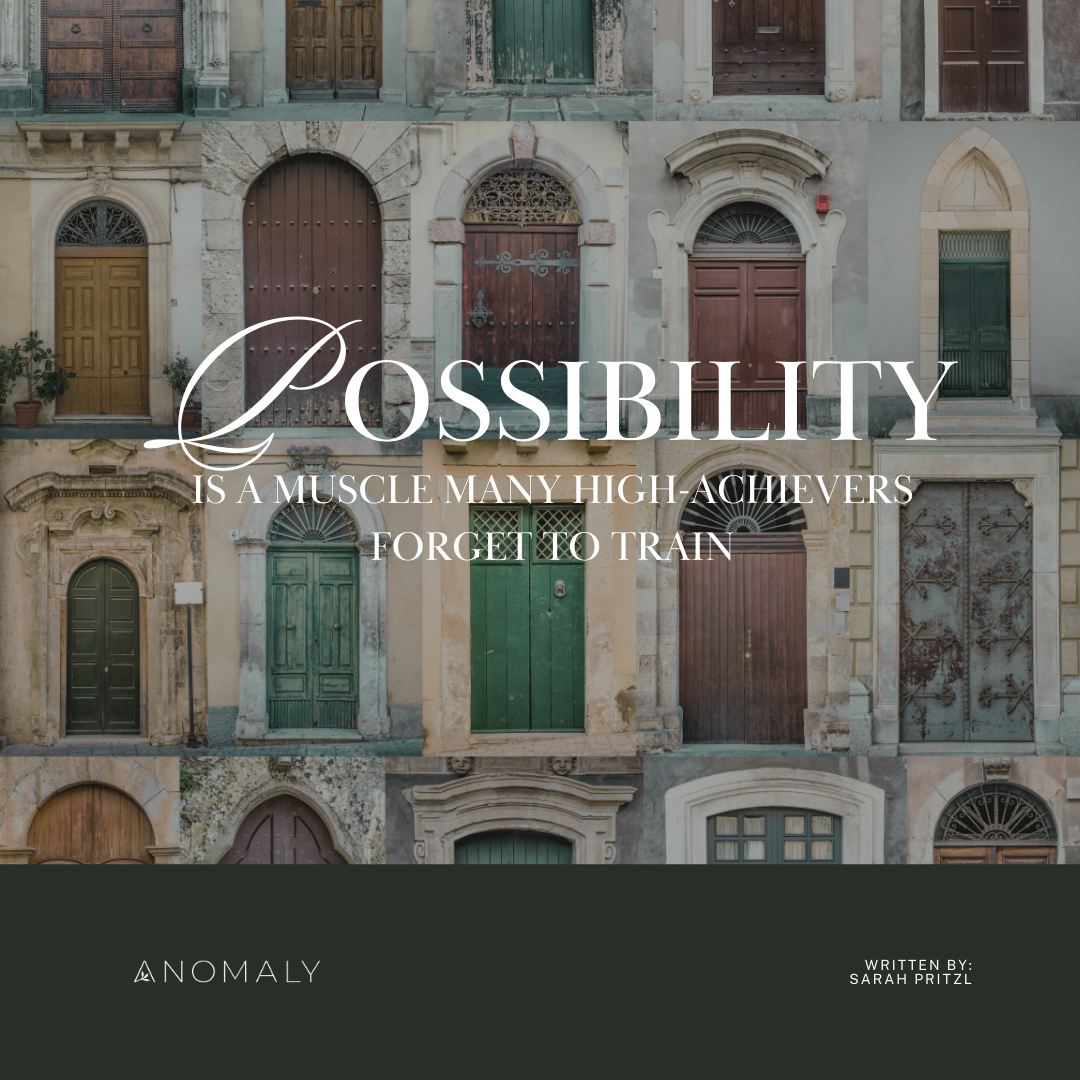
Possibility is a Muscle Many High-Achievers Forget to Train
This was only our first conversation. I wasn’t sure I had built enough trust to ask such a bold question of a potential client, but I chose to follow my intuition nonetheless.
“You’ve referred to yourself as a high-achiever a few times now. If you don’t mind my asking, who would you be without that identity?”
Her energy shifted almost instantly. I watched as her shoulders dropped, her body relaxed. It was as if the rules and constraints associated with her high-achiever identity loosened their grip ever so slightly.
She took a breath before replying, “I would be generous. I would be kind. I would be intelligent, and creative, and hard-working, and deep-thinking…”
I wrote frantically trying to capture every beautiful adjective. When she paused, I looked up and noticed her wipe away a tear.
“Are you open to sharing where this emotion is coming from?” I asked gently, setting down my pen.
“It’s nice to be reminded of all the good that exists behind the “high-achiever” identity,” she said.
In that moment of recognition, in that single tear, it was as if an ounce of hope had been restored. And where there’s hope, there’s possibility.
An Observation
I can remember a similar turning point in my own story – a distinct moment where the rules were stretched enough to create space for something new. A new identity, a new Idea, a possibility. But after connecting with, and coaching, high achievers over the past four years, I’ve noticed that possibility is a muscle many of us have forgotten to train.
How this muscle became overlooked is woven into the identity of what it means to be a high-achiever in the first place.
The “high-achievers” I’m referring to have certainly achieved results. They each have a track record of follow through and success. But it’s worth noting that these particular individuals approach everything they do with an ownership mindset and a deep commitment to personal responsibility. They move through life driven (consciously or unconsciously) by the belief that everything happens as a direct result of hard work.
The problem is, these high-achievers have spent so many years marching along, progressing, and optimizing that they’ve inadvertently forgotten how to create space for possibility. While prioritizing control, routine, and predictability has served them in some ways, it has limited them in others. In our conversations, many have expressed feeling boxed in by the prescribed path they’ve chosen to follow or – like the client referenced above – confined to an identity they’ve since outgrown.
Without space for possibility, these purpose-driven, high-achievers are wildly underestimating just how different their life and work could be… if they dared to imagine it!
Like the fitness fanatic who forgets to factor mobility into their routine, a life without possibility becomes rigid.
Possibility = Flexibility
Over the past four years, I’ve been an active member at FlowFit Yoga and Fitness. The studio’s owner, Alex Johnson, teaches that we don’t have to choose between strength and mobility, “We work to create both for a healthy and balanced body, and a healthy and balanced life.”
Strength training requires discipline and teaches us about our capability. Progress is easy to measure, and results are easy to see. From the outside, we look strong, put together, and successful by society’s standards. All of which feeds the ego. But without factoring in mobility, we’re more prone to injury. Strength training alone is less sustainable long-term and, for those who crave variety, can start to feel a bit routine.
Compare this to living a high-achieving life without stretching the muscles of possibility.
From the outside, you may look strong, put together, and successful by society’s standards. You’ve been disciplined enough to achieve significant results, but success is less sustainable long term. You’re more prone to injuries of an internal or spiritual nature. Overall, you lack the flexibility needed to create the purpose-filled life you’ve been craving.
In my 1:1 coaching, I’ve partnered with clients whose entire identity felt “defined by metrics.” Many were so overwhelmed by the doing that they worried they’d become a “less effective dreamer” and that their intuition had been “washed away.”
More recently, a client admitted she wasn’t sure she’d done enough to even be considered a high-achiever. We laughed at this together because… classic.
It doesn’t have to be this way. Through intentional practice, you can create a life that is both strong and flexible. One that is not confined to a prescribed path or defined by an outgrown identity but driven by the possibility and potential of your future vision. Partnering with a coach can provide the structure and support needed to flex new muscles and create lasting change.
As is true when flexing any new muscle, engagement starts with the forming of new neural pathways.
The Hidden Power of Paradox
No one knows the neural pathways associated with possibility quite like Dr. Jill Bolte Taylor.
On the morning of December 10th, 1996, Dr. Jill Bolte Taylor experienced a stroke that would eventually shut down the majority of her left hemisphere. Prior to this date, she had been working at Harvard as a neuroanatomist, meaning she dedicated her research to mapping the microcircuitry of the brain on a cellular level.
In her captivating TedTalk, Dr. Bolte Taylor vividly describes the morning of her stroke. The blood pooling in her left hemisphere cut off her ability to speak, to understand language, and to feel emotions like shame or resentment.
“Imagine what it would feel like to lose 37 years of emotional baggage!” she jokes.
But the stroke was certainly no laughing matter.
As the pressure in her left hemisphere continued to build, the functionality of her right hemisphere came to the forefront. This nonverbal part of the brain is characterized by holistic, big picture thinking; emotions like compassion, gratitude, wonder; and an overall sense of expansion and oneness.
Without the individualized nature of her left hemisphere, she could no longer recognize herself as separate from the lifeforce energy of the universe. “Nirvana!” she exclaims as she relives this life affirming moment. “I found Nirvana!”
The fact that Dr. Bolte Taylor is alive and able to communicate this story to us is a testament to the brain’s neuroplasticity. It took her eight years to fully recover the functionality of her left hemisphere, and the gift she brought back from this experience is a lifestyle she refers to as Whole Brain Living. The stroke offered her an unparalleled opportunity to experience the possibility often hidden within our right hemisphere’s circuitry and to value the contributions and characteristics of her whole brain in a new way.
Whole Brain Living does not suggest that one hemisphere is better than the other, just as strength is not better than mobility. The process of designing your life is not one of polarity, but of paradox.
If our desire is to design a life that’s filled with more joy, peace, and fulfillment, we have to familiarize ourselves with different parts of the brain. Instead of operating within familiar pathways, the call is to strengthen our innate curiosity, connectedness, and creativity and welcome these right-brain characteristics back into our identity.
Dr. Bolte Taylor closes her TedTalk by saying, “[We] have the power to choose, moment by moment, who and how we want to be in the world.” With practice, we can learn to leverage the power of paradox within us.
Neurologically speaking, we have an innate opportunity to be both
logical and intuitive,
analytical and creative,
thinking and feeling,
serious and playful,
strong and flexible.
We get to move through the world with
effort and ease,
patience and urgency,
fear and courage,
gratitude and ambition.
Although the application of such paradoxes can be tricky, this permission slip is incredibly liberating. There’s baked in grace and fluidity which more accurately reflects the true human experience.
The problem is, much of the world does not know how to navigate such paradoxes. It’s a way of living that is still (unfortunately) quite counter-cultural.
As a high-achiever in today’s society, it’s likely that most of your reality has been shaped by left-hemisphere characteristics such as analytical thinking, structure, control, and independence. Much of our anxiety-ridden culture is stuck in the emotional circuitry of the left hemisphere, comparing, judging, criticizing, and forecasting futures based on emotions of the past. We strive for a definition of success that is individualistic and inherently quantifiable. And because the left hemisphere is the source of ego, our identity gets wrapped up in this perception of reality to the point when our self-worth feels inseparable from productivity and our results.
Choosing to “step to the right of our left hemisphere,” as Dr. Bolte Taylor suggests, is truly revolutionary. It goes against the status quo. But if we choose to familiarize ourselves with more right-hemisphere characteristics and develop the discernment needed to embrace our paradoxical whole selves, we step into a realm of possibility and potential beyond our current perception.
Stretching the Rules
To do this, to change the status quo, you have to be willing to question the rules that currently hold the status quo in place. (If you’re thinking this is true on both a macro and micro level, you are correct. You can read a bit more on that here.)
Rules aren’t inherently bad, but they are inherently limiting. In his book, The Creative Act: A Way of Being, author and music producer Rick Rubin writes, “The most deceptive rules are not the ones we can see, but the ones we can’t.” The deceptive, unconscious rules that most often keep us from flexing the muscle of possibility are the thoughts and limiting beliefs we carry around control, time, productivity, and identity (all left-brain driven concepts).
Such rules aren’t inherently bad. The challenge is learning to approach rules with the openness and curiosity of our right brain. In this way, we can hold them loosely enough to see when they’re serving us and when they’re not. Rules narrow our field of attention and, if not approached with awareness and intention, can keep us from seeing what’s true, including our true potential.
In 1999, cognitive psychologists Dan Simons and Christopher Chabris set out to study attention. They showed participants a pre-recorded video that instructed them to count how many times the players in white passed the basketball. I remember being shown this same video in one of my psychology classes. Much like the participants, I dutifully followed the rules and counted 15 passes made by the players in white t-shirts. The straight-A student in me was proud to have gotten the answer right.
But the video went on to ask a question I didn’t expect, “Did you see the gorilla?”
No, that’s not a typo. In rewinding the video, you can clearly see a person in a gorilla suit walk straight through the center of the screen. The gorilla pauses in the middle of the players, pounds its chest, and walks off.
The researchers’ instructions had narrowed my field of attention, and the act of counting activated the circuitry of my left hemisphere. Like the majority of participants, I was so focused on the rule of counting the number of passes that I failed to see what was right in front of me.
This is the phenomenon (and risk) of selective attention.
It has me wondering… What possibilities might you, might many of us, be overlooking?
The opposite of a restrictive, rules-based field of attention involves moving through life and work with a beginner’s mind. The beginner’s mind is based on a concept at the core of Zen Buddhism called shoshin. It’s a state of openness, wonder, and humility (all right-brain driven states of being). The beginner’s mind is playfully free of pre-established rules and assumptions. Zen monk and teacher, Suzuki Roshi is often quoted saying, “In the beginner’s mind there are many possibilities. In the expert’s, there are few.”
When you’re willing to let go of (or at least question) your thoughts, rules, and limiting beliefs, you can step into a place of creative possibility. This is an essential muscle to stretch as you learn to discover an expanded view of who you are and the impact you can make in this world. And the results are well worth the effort.
You’ll remember the potential client I referenced at the start of this article. Hidden behind her high-achiever identity lived someone who was generous, kind, intelligent, creative, hard-working, and deep-thinking. This whole, beautiful person and I ended up partnering together in coaching and after three months, this is how she described her experience:
“Sarah sits squarely at the intersection of curiosity and clarity. She helped me question assumptions I’d made about who I was and what the world expected of me, while also nudging me back toward the foundational elements of my own creativity. She reminded me that growth doesn’t always come from pushing harder - it often begins by creating more surface area for what we want to come into existence.”
Creating Space for What You Genuinely Want
In the story of Wicked, there’s a significant turning point in Defying Gravity whereby Elphaba sings, “Something has changed within me. Something is not the same. I’m through with playing by the rules of someone else’s game. Too late for second-guessing. Too late to go back to sleep. It’s time to trust my instincts, close my eyes and leap.”
Shortly before this, Glinda tries to convince Elphaba to apologize to the wizard. She reminds Elphaba of the dream she’s “worked and waited for” since she was a child. But this dream of being with the wizard is no longer what Elphaba genuinely wants. A veil has been lifted. She’s questioning the rules. She’s finding clarity and shedding light on a new, unlimited potential future.
I believe this song resonates so deeply with people because it speaks to something universal: the desire to free ourselves from the rules and expectations weighing us down and move toward what we genuinely want to create, experience, and contribute to in this lifetime.
In my work, I refer to the things we genuinely want to create, experience, and contribute to in this lifetime as Ideas, and I believe your Ideas can be catalysts for both personal and societal evolution, if you let them.
But knowing what you genuinely want and having the courage to champion those Ideas isn’t easy. It stirs up a lot of fear: fear of failure, fear of disappointment, fear of what other people might think, fear of change. It’s also difficult because there are so many opinions from books, podcasts, leaders, and social media influencers about what we should want.
Shout out to Catherine Brine who put it this way, “Many of us were rewarded for being responsible, helpful, high-achieving, or agreeable. Over time, we can get very good at meeting expectations and very disconnected from our own desire.”
In one of our coaching sessions, a client and I were discussing his definition of discipline, which he described simply as, “doing what you should do.”
I asked in reply, “Should… according to whom?”
He laughed in response (as most clients do) while his brain hunted for an answer. He hadn’t considered this question before. Where were all of his shoulds coming from?
Should is simply an unseen rule disguised as common sense or well-meaning advice from an often-unidentified source. The point of my question is not necessarily to identify the source, but to make clients more aware of the rules shaping their status quo, many of which they haven’t even set themselves.
Living under the veil of should is a way of denying and distrusting your own instinctual voice, your own natural exploration, and the learning that comes from that process. Robbing yourself of that learning also impacts your confidence (self-trust).
After sharing this perspective with this client, I referred him back to his original definition of discipline as “doing what you should do” and asked again, “should, according to whom?”
“My future self,” he replied, resolutely.
With his attention (re)grounded in his own life rather than the rules of someone else’s, his field of attention was open enough to hear what he genuinely wanted to create, experience, and contribute to in his lifetime… and who he could become along the way.
Only the Beginning
Learning to stretch the muscles of possibility is only the beginning of creating a purpose-filled life. In her book What You Want Wants You, author Suzanne Eder writes, “As you get better and better at focusing on what you want, your ability to turn possibilities into probabilities gets stronger and stronger.”
I’d personally edit this quote to say that your ability to turn possibilities into probabilities will get stronger and more flexible.
According to the World Economic Forum’s 2025 Future of Jobs report, flexibility and agility will be among the top five core skills required by 2030. And that’s not to mention the impact/value of these skills outside of the workplace.
If this article resonated with you, if possibility feels like a muscle you’ve forgotten to train, know that it’s one thing to learn these concepts in theory and another to practice them in reality. As I mentioned earlier, this flexible, paradoxical way of living is still quite counter-cultural. It’s easy to be deceived by and fall back on old rules in new circumstances.
This is why it can be beneficial to partner with a trusted coach – ideally, one who reminds you to trust yourself, who teaches you to flex new muscles, and who gently challenges you to see bigger, different possibilities.
Much like working out, getting started is the hardest part.
When you're ready, take the first step by scheduling an introductory call. In this free 45-minute conversation together, we’ll explore your current situation and where you might be feeling stuck; we’ll talk about what’s worked and what hasn’t worked for you so far; and, if we choose to partner together, we’ll clarify what progress might look like in the months ahead.
I can’t wait to see what possibilities you’ll uncover!
Sources and Additional Information:
Bolte Taylor, Dr Jill. “My Stroke of Insight.” TED, Feb. 2008, www.ted.com/talks/jill_bolte_taylor_my_stroke_of_insight.
Bolte Taylor, Dr Jill. Whole Brain Living: The Anatomy of Choice and the Four Characters That Drive Our Life. HAY HOUSE UK LTD, 2022.
Eder, Suzanne. What You Want Wants You. Say Yes Quickly Books, 2023.
Rubin, Rick. The Creative Act: A Way of Being. Penguin Press, 2023.
Simons, Daniel J., Chabris, Christopher F. (1990). Gorillas in our midst: sustained inattentional blindness for dynamic events. https://www.chabris.com/Simons1999.pdf
World Economic Forum. (2025). Future of jobs report. https://www.weforum.org/publications/the-future-of-jobs-report-2025/
